"
THIS IS PARKINSON´S
TEN YEARS LATER
"
2014
“Sometimes dad can hardly eat, but other times he can do everything.
He’s almost like Superman and Clark Kent.”
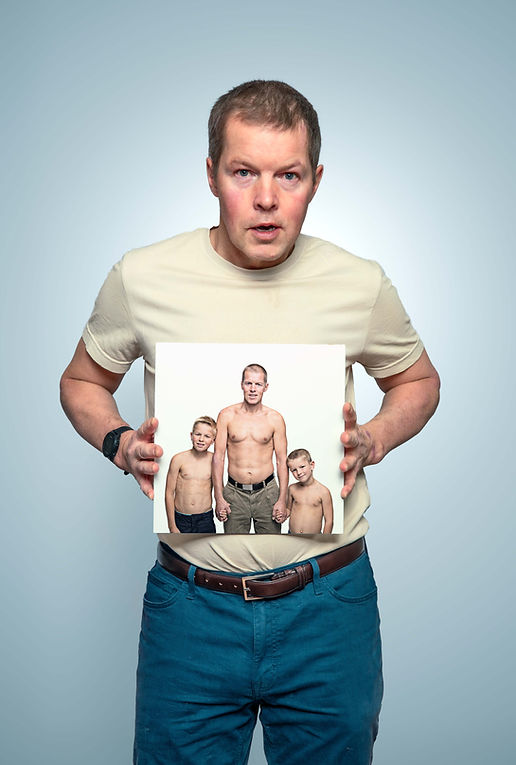
Tommy Olsen
Share this story
"
2024
“That was our youngest, Eirik, who said it so well,” Tommy tells me.
In 2009, Tommy Olsen (57) learned he had Parkinson’s disease. He was only 42.
The athlete from Ottestad in Norway was European Champion in Ski Orienteering and had won several World Championship medals. But when he appeared in This Is Parkinson’s in 2014, the powerful machine was starting to falter.
Things were even worse when I visited him in his house four years late, in 2018.
By then he had developed severe fluctuations between “on” and “off”—the periods when medication works and when it doesn’t. In an “off” phase, he could barely move a small sofa cushion to sit down. But the worst part was the mental strain. He described it like this:
“When you’re physically off, you’re mentally off too—you’re mentally ill. I call it ‘the big black hole.’ And when you’re in that hole, you can’t see any way out.”
“The man who loved being active sometimes couldn’t even take part in family life,” says his wife, Stine.
But Tommy wanted his boys to feel that, despite the illness, they had a dad who cared about them—and all the kids in the neighborhood. So he spent a lot of time creating activities for children and young people. In 2016, he received the Ottestad Sports Club Honorary Award for this.
“That might be the greatest award I’ve ever received,” he says quietly. “It showed that even when you’re sick, you can give something to others. It showed that my fight wasn’t just for me.”
That same year, Tommy had DBS surgery. He describes the brain operation as hell—but the result as one of the greatest things he’s ever experienced.
“They said DBS wouldn’t make me better at my best, but that it should keep me from sinking deep into the black hole—and they were right. It was a real boost. I skied the Vasaloppet long distance race, and it went well. The Birkebeiner Race too. I was actually better at my best too, and I hardly needed any medication.”
“My boys were proud of their dad and at the same time… eh… things went really well for 4–5 years. I managed to… when the words don’t come anymore… I can’t find the word.” Tommy takes a deep breath and says:
“The first year was a dream. Then I gradually got worse.”
Even with Parkinson’s and everything that comes with it, he was able to work as a coach at the Wang Sports Academy. But in 2021, he had to throw in the towel and go on disability. That hit his self-esteem hard.
“When I worked at Wang, I had to expose myself with Parkinson’s. After I quit, I became a bit scared and skeptical about situations I wasn’t comfortable with. I had to know exactly who I’d meet in advance—and it’s still like that sometimes.”
“Can you manage on your own today?”
“No. Without Stine, I wouldn’t be here. She’s the one holding the family together. She deserves much of the credit for how well things have gone.”
“How do you keep your spirits up?”
“I do things I enjoy. I’ll keep skiing as long as I can. Before I met you today I did an hour of spinning and strength workout. To not be doing physical activities was never an option for me—I think it’s important.”
“It’s a terrible disease,” says Stine. “You’re trapped in your body. And it shapes our lives more and more. It’s hard over time to watch the disease take more and more from the man I love—and to have to help him more and more. I feel I have less freedom than my friends, but I try to make the best of every day.”
“At least it’s not a deep depression anymore. He’s out every day, training and doing things.”
Tommy has recently started using a new technology—Produodopa—a medication pump he wears on his stomach that delivers levodopa directly into the bloodstream through a needle under the skin. This means fewer fluctuations than with tablets, which have to go through the digestive system.
“It also works at night, so he sleeps much better and is able to turn in bed without help—and that means a lot to me.”
His most troublesome symptoms are stiffness and slowness—both in body and mind. Communication is harder. But when I ask if things are better today than he feared they would be ten years ago, he says yes.
“Thanks to DBS?”
“Yes. And to Stine. And the pump. And the workouts.”


