"
THIS IS PARKINSON´S
TEN YEARS LATER
"
2014
«It’s like with the bullfighter and the bull. When the bull enters the arena, it is him and me.
I try to read his moves. I dodge. We find new positions, new attacks—I manage again.
The fight will last a lifetime, and the outcome will be fair. I know I can’t kill him.
The nights are the worst. He’s right there. I hear his breath.»
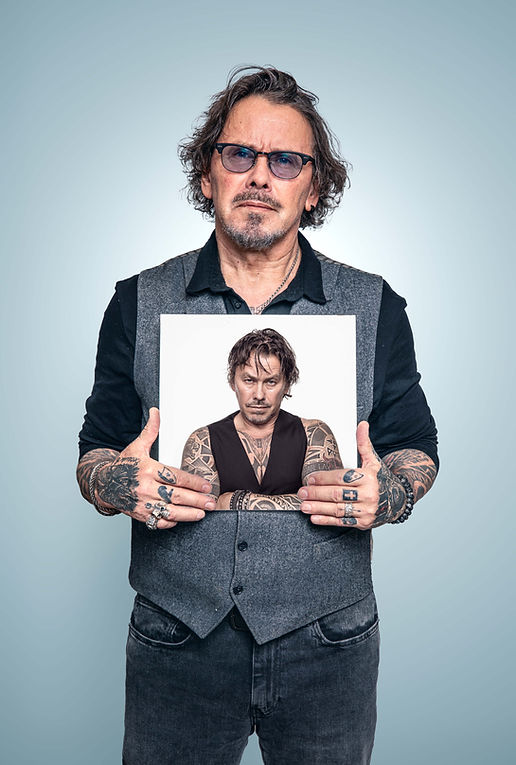
Eivind Øyslebø
Share this story
"
2024
This is Parkinson’s was a boost - it did something for my confidence to get so much attention. I decided that instead of walking around dissatisfied, I’d try to enjoy the years I had left. And that had consequences.”
”My wife and I split up. It might not sound so positive, but today I know she’s happier in her way, and I’m happier in mine.»
Eivind Øyslebø (66) was the oldest participant in the photo exhibition about young people with Parkinson’s disease. Today, his three daughters are grown up, and he’s been a grandfather for a long time.
Now he sits on a stool in his art studio, located in a former office near what used to be the control tower at Oslo Airport. The walls are covered with his artwork.
Eivind speaks calmly, in a softened Valdres dialect. An aging but still golden and muscular body is almost completely covered in tattoos.
“There’s a lot of text on my body,” he laughs. One of them reads: Aguilas non captat muscas—“Eagles don’t catch flies.”
Or, in his words, “Don’t sweat the small stuff. See the bigger picture.”
In the years after his diagnosis, he tattooed many such words of wisdom on his body—words about how he wants to view life.
Another Spanish saying is about facing the bull you meet—you can’t lie down in the ring or ask for another.
“I got Parkinson’s. That’s that.”
He has extensive experience as a child welfare educator, with training and practice in coaching, multicultural understanding, and as a sexologist. He’s used to talking to people about what troubles them. He’s attentive and present. Problems don’t scare him.
“I worked 45 years with people, but a few years after my Parkinson’s diagnosis in 2009, the disease started to drain my energy. And you can’t say to a mentally ill patient you’re responsible for, ‘Sorry, don’t run away today—I’ve got fatigue.’ So I scaled down before becoming disabled in 2019.”
He started an art gallery, but then the COVID pandemic hit and he had to close.
“It was a huge letdown, and it made me feel Parkinson’s more than before. My strength has always been talking to people, but when you sit there, more or less afraid to go out, it’s easier to feel sorry for yourself.”
Something has changed in his speech—his words sometimes stutter. The man who once ran with the bulls in Pamplona is slower now.
Before the pandemic, he bought an electric scooter, but he crashed it, tearing tendons and muscle attachments in his shoulder and needing knee surgery.
He says he’s always trained a lot—5–6 days a week since childhood—but now his physical condition takes a hit.
“For me, it’s two words: fate and acceptance.
Fate—you can’t do anything about it. I know I have Parkinson’s, and I have to live with it. Acceptance—that it’s a progressive disease—I also have to live with. How fast it progresses isn’t up to me alone, but I do my best.
I don’t like the phrase ‘Fight Back,’ because I’m not fighting against Parkinson’s—I’m fighting with it. Fighting against it means you expect to win. I don’t expect to win. I expect that he and I will adapt to each other.
Sometimes I have to give in and can’t do what I used to. And sometimes I notice I’ve regained things I thought I’d lost—like smell and taste.”
“How did that happen?”
“I think it’s thanks to Greta, my girlfriend, who loves food and drink. She’s gotten me to dive deep into scents and flavors. She describes the smell, and it’s like the memories are pulled up and I can sense it.”
Eivind doesn’t often meet others with Parkinson’s. He trains at a regular gym and does quirky exercises throughout the day, starting from when he wakes up—like standing on one leg while brushing his teeth.
His medications include Sinemet 250 mg daily, Oprymea 0.44 mg, Cipralex 10 mg. He also takes lion’s mane mushroom and cod liver oil in months with an “r.”
When This is Parkinson’s launched in 2014, Eivind was pictured in Aftenposten on his Harley Davidson. Today, the motorcycle is sold, and a walking stick has appeared.
Eivind has stepped into old age, and he wants to be there—with dignity.
“I’ve become focused on how to have a good old age with Parkinson’s. In Norway, we cling to youthfulness, while Greeks and Turks seem content when they grow old. Despite sore backs and walking sticks, they head to the café and sit down. They don’t need to run around doing the Birkebeiner race.”
Every two weeks, he has a long, meaningful conversation with a priest. And he loves spending time in the forest. He fishes—for hours. Shows his grandchildren how it’s done. He senses the rain, the smells, the tastes.
“I think maybe that’s the secret to successful aging—not to fight it, but to embrace it. Live with it, not against it. You age in a more distinct and peaceful way, and that actually suits someone with Parkinson’s.”


